Sharp Focus Realism In Oil by NICK BAXTER


  Please contact me through email to inquire about pricing of any original fine art pieces on this site, or for future commissions. Here you can view any reproductions or other products I have available for purchase at this time. Everything on this page must be bought through the source listed with each item, they cannot be bought directly off this website. If there is no third-party source listed, then you can mail-order the item from me personally if it's not sold out. Please email me if you have any questions, or to check for availability of certain items.


Nick Baxter www.nickbaxter.com Although still in his first decade in the tattoo profession, Nick Baxter already has long established himself as an artist worth watching, someone with a very personal artistic look executed with a level of technical excellence found in very few tattooists. Within his first year of working on skin, examples of Nick's work began appearing in magazines, catching the tattoo world by surprise, and he hasn't slowed down since. In addition to his mind-blowing tattoo work, Nick has also produced a significant body of painted works; his painting style incorporates classic old master's techniques but approaches them from another angle. He has produced a small booklet, The Fundamentals Of Realist Oil Painting, describing these techniques in detail. Since painting techniques have so many parallels with tattooing and exploration on canvas or board can be so helpful in developing better tattooing technique, Nick's book is a great place to start for any tattooist wanting to take a first look at painting techniques, as it offers college-level information in a short, concise format.
 
By Nick Baxter Renowned tattoo artist and oil painter Nick Baxter has condensed over 10 years of artistic knowledge into one book. Both formally schooled in oil painting at the college level and self-taught through years of honing his style in the tattoo industry, Nick brings these two worlds together into a simple formula in his specialty: Sharp-focus realism. Aimed specifically at helping tattoo artists who are seeking to expand their artistic practice into a second medium, this book makes many helpful comparisons between the tattoo and painting mediums; at the same time, it encompasses enough information to be of immense value to all aspiring realist oil painters, from beginner to intermediate level. Nick discusses in-depth strategies for developing precise technical skills and a unique personal style, in the process revealing many of his own techniques and preferences including a groundbreaking section offering critical insight on the often-overlooked mental game of creating inspired works of art. Laced throughout with full-page color plates of a wide selection of Nick’s paintings throughout the years, this book will satisfy not only aspiring painters but also fans of Nick’s art, and of realism in general. Printed in North America on recycled paper, using eco-friendly inks. 
 

Sharp Focus Realism In Oil


AVAILABLE NOW!


FOR ORDER N MORE INFO
WWW.HELLBOBS.COM

Tattoo Education :

Tattoo Education :
Nick Baxter www.nickbaxter.com Although still in his first decade in the tattoo profession, Nick Baxter already has long established himself as an artist worth watching, someone with a very personal artistic look executed with a level of technical excellence found in very few tattooists. Within his first year of working on skin, examples of Nick's work began appearing in magazines, catching the tattoo world by surprise, and he hasn't slowed down since. In addition to his mind-blowing tattoo work, Nick has also produced a significant body of painted works; his painting style incorporates classic old master's techniques but approaches them from another angle. He has produced a small booklet, The Fundamentals Of Realist Oil Painting, describing these techniques in detail. Since painting techniques have so many parallels with tattooing and exploration on canvas or board can be so helpful in developing better tattooing technique, Nick's book is a great place to start for any tattooist wanting to take a first look at painting techniques, as it offers college-level information in a short, concise format.

Tattoo Education :Greetings from TattooEducation!:

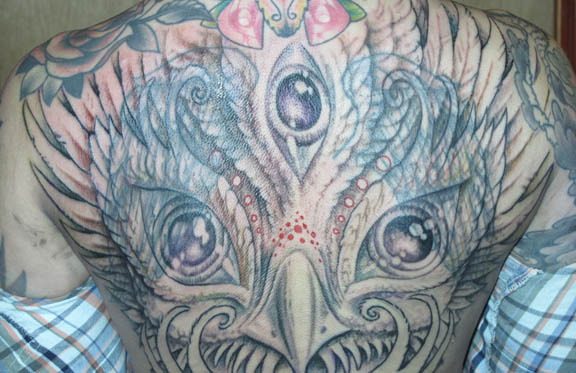
I just did a second pass on a big backpiece coverup tattoo project I've been working on this year, and thought I'd share the photos and talk a little about my strategy. This was a backpiece request, something to cover a pair of fairly old, semi-faded undersized angel wings:


Now, the traditional approach to coverup tattoo projects has always been to go dark, and try to overwhelm the old tattoo. The problem with this approach is that the outlines of the old tattoo almost always show through, even with solid black tribal work, making the piece look like an obvious coverup. Part of the reason for this is a fundamental misunderstanding of coverup tattoos. In reality, you don't cover the old tattoo- you mix it with the new one. All of the pigment particles from both tattoos, old and new, will ultimately reside in the same layers of skin, once the healing and settling have taken place. Knowing this, the best way to hide an old tattoo is to try to absorb it into the new one. Fortunately, my client's request was for a totem pole made of birds, meaning that I could hide the feathery pattern of the old tattoo in the feathery details in the new piece. With the right amount of detail, the new tattoo should be able to capitalize on what's already there. In this stencil, you can see how this works:

For larger work, I tattoo most efficiently on many types of projects by starting magnum first. In this case, I used a 5 magnum, which has very low skin resistance, allowing for quick work. It's also a small enough needle group to rough in bold lines while being wide enough and spread enough to permit some basic rough shading and color gradients. In this first step, I aimed to work the detail in such a way to help conceal the old tattoo as much as possible, without creating a dark region in the tattoo:

backpiece coverup tattoo

At this point, the old tattoo is already starting to get buried in the new one. The next step, though, allows for selective saturation in just the right places: the tightening stage. After finishing with that initial magnum pass, working with a 5 or 7 round permits the refinement of edges and cleanup and darkening of key details, in such a way as to make the tattoo much stronger:


This consists of darkening the bold lines made with the 5 magnum and saturating the feathery details in such a way as to incorporate and camouflage the old outlines. The old tattoo is really starting to fade into history here. After that, I had to move pretty quickly with the color, since the client was in pain and needed me to finish as quickly as I could. Since I knew we'd have another chance at a later date to really saturate the color, I focused on the coverup areas and laid down as much color as possible in that short time using a 13 magnum. At the very end, I switched to a small magnum and blasted white over the remaining obvious coverup areas:
color backpiece tattoo coverup

In this first session, I deliberately aimed a little light, knowing I would have a second (and third, if necessary) chance to add more detail, saturate the color more and do whatever necessary to really hide the old piece. I knew this first pass would heal light, which it did:

coverup backpiece tattoo

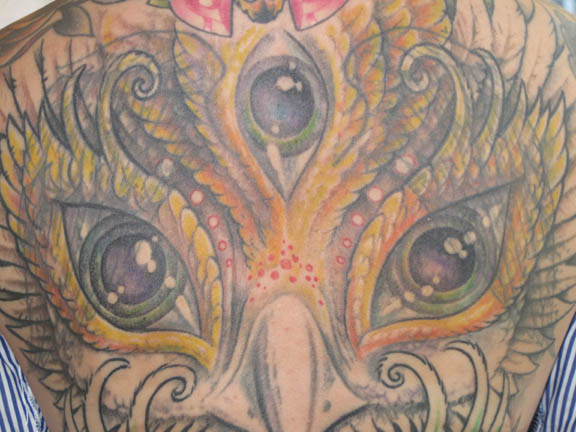
However, it made for a really solid foundation for the second pass. This time through, I first got into it with a 5 round to work all the detail, using a combination of black and color to try hiding the remaining unwanted old detail. I then made a thorough second pass with a 13 mag through all the color, then resaturated it in key places with a 7 mag. With the magnum pass finished, I spun through one last time with the 7 round and some of the lighter colors, then some white highlights:

 This tattoo is not necessarily finished- I anticipate needing a final pass through the coverup zone, darkening the details another step and going deeper and more saturated with the color in select places. A big part of the job, though, is in also adding similar amounts of detail and rich color throughout the whole backpiece, as such:

Part of the art of coverup tattoos is in accepting that a small amount of the old tattoo may be visible, and distracting the eye from that with strong detail and movement. Using large areas of black shading over the old wings would not have made the piece look any less like a coverup- on the contrary, it would look even more like one.


I plan on putting together the big book on coverup tattoos in 2011. In the meantime, though, you can learn all kinds of great stuff from the items in our existing catalog, including detailed techniques on all styles of tattooing. Remember that many of the items in our catalog are only shipped to professional tattoo studios- you don't want to be the tattooist doing the work that we have to cover up!


Happy tattooing, and I will be in touch soon!


Guy Aitchison

www.tattooeducation.com

www.hyperspacestudios.com

www.protonpress.com

Focusing on Chemistry Instead of Compassion: Psychiatry Takes Another Step in the Wrong Direction by William Glasser M.D.


Based on his new book, Choice Theory, A New Psychology of Personal Freedom, William Glasser M.D. takes issue with the new current psychiatric belief that almost all psychological problems are based on disturbed or imbalanced brain chemistry. Along with this, he suggests that our current psychiatric diagnoses are wrong and potentially harmful to the people so diagnosed. Finally, he claims that the way we usually do psychotherapy, concentrating on the past instead of the present, may do more harm than good.

Since starting my psychiatric training in 1954, I have been questioning much of the conventional psychology of the profession I love. For example, from the beginning, I totally disagreed with the idea that people are not responsible for their actions, that they should be seen as helpless victims of their parents or others who have mistreated them or of traumatic events they have been exposed to. We are not the victims of our past unless we choose to be so.

Further, I strongly believe that all psychiatric diagnoses--usually thought of as mental illnesses--are not only wrong, they are harmful to the people so labeled. People, including those commonly called schizophrenics, are not mentally ill unless there is obvious brain damage, as in Alzheimers Disease.

As far as psychotherapy goes, I vigorously opposed, and still oppose the idea that people can only be helped by endlessly visiting and revisiting past misery; that they must come to grips with this misery or they cannot function effectively in the present. This psychiatric obsession with the past is not only counter-therapeutic, it increases the cost of therapy to where few people can afford it or afford the insurance that could pay for it if it was not so time consuming. The more the therapist works backward and sees clients as helpless victims of what has happened to them, the less chance they have of being helped. It is not unfair to say that the longer the therapist remains in the past, the less chance the therapy has to be effective.

I believe that there is only one basic psychological problem. Either a person suffers from a present unsatisfying relationship or he or she has no satisfying relationships at all. While there may be countless variations of how people choose to deal with the unsatisfying relationship--variations commonly called mental illness--the answer to all psychological problems is improving a present relationship or finding a new, satisfying one. I have practiced psychiatry for over forty years and every person I have seen has this underlying problem. I have lectured to thousands of therapists and counselors and have never had anyone question this contention once they thought about it. If psychotherapists would let the past go and focus on the present relationship problem, the time needed for effective psychotherapy could be substantially shortened. Ten sessions would be enough to get most people started on the road to a better life.

But to use this insight most effectively, the theory of achieving satisfying relationships that I call Choice Theory, should be taught to all students, teachers and to as many parents who are willing to learn it. The cost would be inconsequential because it is easily and quickly taught. People young and old love learning it and many schools are now doing this successfully. Wherever this has been done, we have evidence to show that students get along much better with each other and get more involved in learning. Teaching Choice Theory would also do much to prevent the violence and other problems that now plague so many schools. But what alarms me most is the present direction of psychiatry, to replace psychology altogether with the pseudoscience of brain chemistry. We are now being bombarded by the media with the idea that what is wrong with most people who have already been mislabeled as mentally ill or are addicted to brain-active drugs is that their brain chemistry is out of balance. The cause of this sudden epidemic of neuro-chemical imbalance is not explained but it is usually blamed on a genetic aberration that has not yet been pinpointed, yet must be there.

The current brain psychiatrists who stare at computer screens depicting the brain in action have reduced our lives to brain chemistry. They reject the idea that they are staring at the brains of lonely people engaged in a wide variety of unsuccessful attempts to get connected to another human being and are desperately in need of compassionate, expert help to find better ways to relate. I have listened carefully to these authorities on many documentaries and have yet to hear even one of them ask a client if he or she is having problems with a relationship. Instead, they tell us that, in almost all instances, these lonely people are the victims of a brain that does not

function normally. We are treated to computerized visualizations of these abnormalities and told that what is seen on the screen is the cause of the illness or addiction and cannot be corrected until the brain chemistry is

normalized with psychiatric drugs such as Prozac. I am not saying that these drugs are never indicated, they do reduce symptoms and help clients to be more amenable to help or to help themselves. But they do not address

the core problem, unsatisfying relationships, which is best dealt with by effective psychotherapy.

It all seems so convincing; after all, if it's on a computer screen operated by a doctor in a white coat, how can it be anything but scientific? And even though what is seen on the computer screen is an accurate representation of what is going on in the brain at the time, the assumption that it's the cause of the problem is wrong. Just because two things happen at the same time, does not make one the cause of the other. This unproven association is the basis of much pseudo-science; malaria was once blamed on bad night air, mal air.

What is actually seen on the computer screen is what should be expected to be seen: it is the brain activity that reflects what the client is choosing to do at the time. If the client is choosing to depress, (usually called depression but I think it is more accurate to use verbs to designate chosen behaviors) this is the brain physiology associated with that choice. If this same person gets help and chooses to be happy then a more normal physiology will be seen on the monitor. The screen reflects the choice, whatever it may be; it does not reflect the cause of the unhappiness. But if all that is observed are the brains of unhappy people, it is easy to jump to wrong conclusions.

If the brain were actually the problem, psychotherapy would not work and no one would recover from an addiction; for example, alcoholics could not get help by going to AA. But huge numbers of people do get help from good psychotherapy that focuses on improving their present relationships. Research has proven this over and over, and millions of people are in recovery from every known addictive drug including nicotine, perhaps the most addictive of them all.

What AA and other 12-step programs offer is a chance to repair an old relationship or find a new, more-satisfying one. If, as many brain chemistry psychiatrists claim, the addictive drug permanently damages the addict's brain to the point that the addict can't do without the drug, there would be no recoveries at all. The brain psychiatrists can't explain--or don't want to try to explain--how good addiction treatment that leads to better relationships can give the addict the strength to resist the desire for the drug enough to stay clean for years, many for the rest of their lives. If I were one of the brain psychiatrists, I would study the brains of people with good relationships and compare them with the brains of people who have poor or non-existent relationships. That might be information that could show the difference between effective and ineffective psychological intervention.

The book, Choice Theory, A New Psychology of Personal Freedom (HarperCollins, 1998), revisits what has been explained here in much greater detail, but focuses on how all of us can use Choice Theory to lead more effective lives through learning how to relate much better to each other in marriage, with our families, in school and in the workplace. The book also shows how one community, Corning, New York, has embarked on an unprecedented

five-year project to teach everyone in the community--over ten thousand people--Choice Theory. They believe that this will improve every aspect of community life.

Brief Overview of Choice Theory

The 1998 book, Choice Theory: A New Psychology of Personal Freedom, is the primary text for all that is taught by The William Glasser Institute. Choice theory states that:


- all we do is behave,

- that almost all behavior is chosen, and

- that we are driven by our genes to satisfy five basic needs: survival, love and belonging, power, freedom and fun.


In practice, the most important need is love and belonging, as closeness and connectedness with the people we care about is a requisite for satisfying all of the needs.


Choice theory, with the Seven Caring Habits, replaces external control psychology and the Seven Deadly Habits. External control, the present psychology of almost all people in the world, is destructive to relationships. When used, it will destroy the ability of one or both to find satisfaction in that relationship and will result in a disconnection from each other. Being disconnected is the source of almost all human problems such as what is called mental illness, drug addiction, violence, crime, school failure, spousal abuse, to mention a few.


Relationships and our Habits


Seven Deadly Habits:

1. Criticizing

2. Blaming

3. Complaining

4. Nagging

5. Threatening

6. Punishing

7. Bribing, rewarding to control


Seven Caring Habits:

1. Supporting

2. Encouraging

3. Listening

4. Accepting

5. Trusting

6. Respecting

7. Negotiating differences


The Ten Axioms of Choice Theory:

1. The only person whose behavior we can control is our own.

2. All we can give another person is information.

3. All long-lasting psychological problems are relationship problems.

4. The problem relationship is always part of our present life.

5. What happened in the past has everything to do with what we are today, but we can only satisfy our basic needs right now and plan to continue satisfying them in the future.

6. We can only satisfy our needs by satisfying the pictures in our Quality World.

7. All we do is behave.

8. All behavior is Total Behavior and is made up of four components: acting, thinking, feeling and physiology.

9. All Total Behavior is chosen, but we only have direct control over the acting and thinking components. We can only control our feeling and physiology indirectly through how we choose to act and think.

10. All Total Behavior is designated by verbs and named by the part that is the most recognizable.

STANDARD PROCESS AND INFO TO GET INKED BY ME

inspiration depends on the individual piece or idea, so if you have something in mind that doesn’t seem like a typical piece for me, feel free to run it by me and if I’m into it, you’ll know. and PLEASE . THINK BEFORE U GET INKED!!!